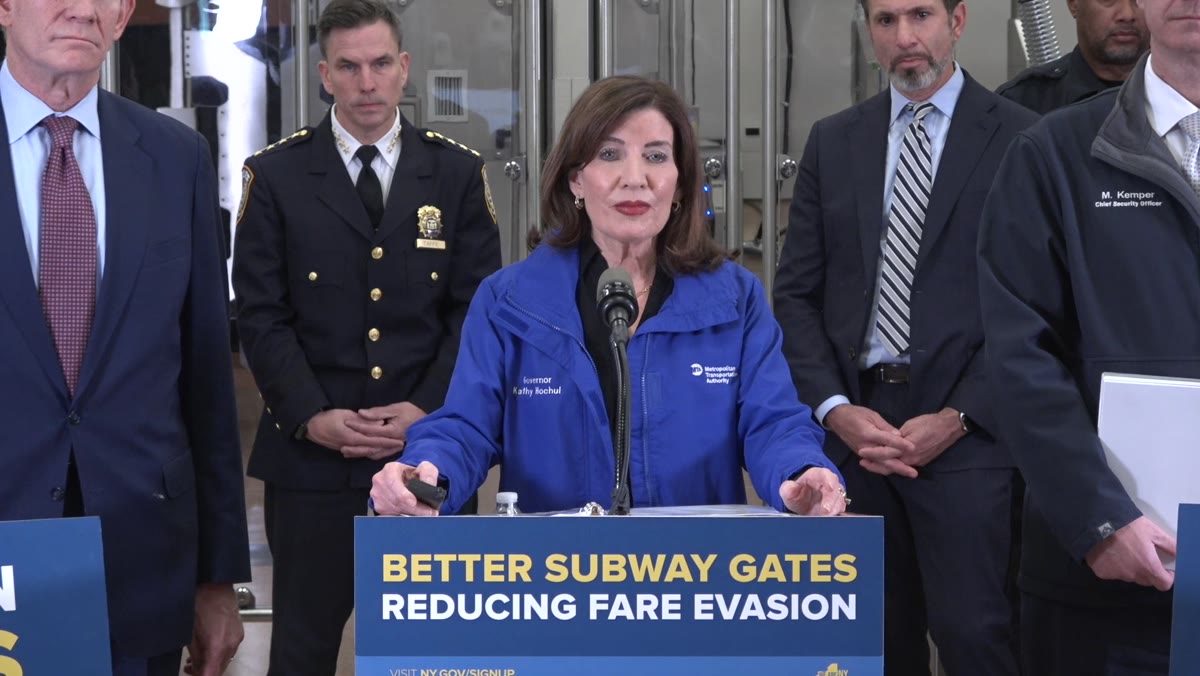
Gov. Hochul announced Wednesday that the Metropolitan Transportation Authority will install modern fare gates at 20 additional subway stations across Queens, Brooklyn, Manhattan and the Bronx, expanding on a pilot program that began at 20 stations.
Hochul said the pilot, which replaced old turnstiles with gates featuring sensors and double doors, cut fare evasion by an average of 35% across the 20 pilot stations, with a 72% reduction at two of them.
"This is just the next phase. It's just the beginning," Hochul said, adding that the MTA intends to eventually install the gates at all 472 subway stations.
The expansion is funded through a $1 billion piece of the MTA's five-year, $68 billion capital program, according to the agency's president and CEO, who said 150 stations are planned to get the new gates under the current capital plan, covering 75% of ridership.
The MTA's president and CEO said the fare gate project followed years of other steps to curb evasion, including hiring guards for emergency exit gates and making physical changes to existing turnstiles, which he said had already produced a 30% reduction in fare evasion before the new gates were tested.
Hochul said the gates also improve accessibility for riders using strollers, wheelchairs or luggage. "As a mom, I know what that's about," she said, describing the difficulty of getting children through old turnstiles.
Asked by a reporter about fare evasion data at one specific subway complex, the MTA's president and CEO said the pilot had reduced evasion from 11.6% to 3.9% at that location, a 66% reduction, and said the next phase would replace every fare array at each of the 20 stations rather than a single array.
Asked whether fare evaders were simply shifting to stations without the new gates, an MTA official said the agency was not seeing a dramatic shift or displacement so far. The MTA's president and CEO separately said fare enforcement on buses would rely on agents checking that riders had paid, since buses do not have turnstiles or fare gates.
Asked about which of several vendors involved in the pilot performed best, the MTA's president and CEO declined to compare them, saying all of the companies met the standards needed to be invited to bid in the next phase of the project.