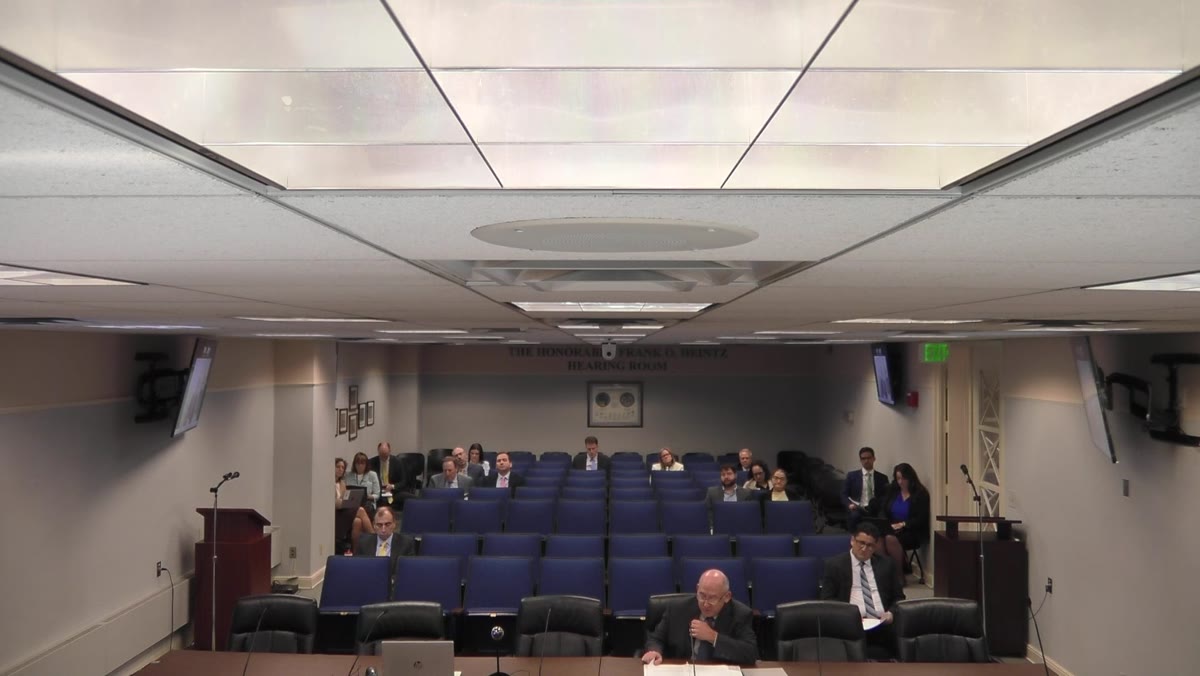
The Maryland Public Service Commission held a hearing Friday on whether Baltimore Gas and Electric and Potomac Edison should seek to opt out of a new PJM program that would lock in electricity capacity costs for 15 years instead of the usual three, with utilities, consumer advocates and other speakers offering competing plans for how to do it.
William Fields of the Office of People's Counsel told the commission that without state action, PJM's Reliability Backstop Procurement could saddle BGE zone customers with up to $79 million and Potomac Edison zone customers with up to $483 million in costs over 15 years. He said the opt-out window with PJM runs from Sept. 30 to Oct. 21.
Fields proposed that large-load customers, such as data centers, be given three options: commit to pay the backstop costs with collateral, bring new capacity to offset the load, or join a peak-shaving program. He argued the commission has authority to make such a program mandatory even though the underlying statute describes it as voluntary. "PJM's proposal provides an opportunity for another plan to eliminate that financial risk for non-large load customers, and that should be plan A," Fields said.
Commissioner Suchman said the 15-year cost lock-in could interfere with the commission's other affordability work. "I am concerned that what PJM is proposing will undermine all the other good work that we are trying to do to address very high capacity prices," Suchman said.
One speaker urged the commission to require operational, not just financial, penalties for large loads that fail to curtail power use, citing a July incident in Virginia in which a sudden drop of 3 gigawatts of data center load caused voltage and frequency fluctuations felt from Virginia to Illinois. "Operational penalties are the only penalties that are strict enough to ensure that large loads are adequately incentivized to reduce their demand," the speaker said.
Potomac Edison's representative proposed instead that the commission order a tariff requiring large-load customers to post collateral or lose firm service if they do not guarantee payment of their share of backstop costs, saying the utility needs commitments by Oct. 21. "But we need to know by October 21st that we have the commitment from those customers and that we have a consequence for those customers if they don't," the representative said.
BGE's representative raised concerns that a mandatory program could face legal challenge and said some large-load customers counted in forecasts are not yet actual customers, complicating any tariff requirement. A representative for Southern Maryland Electric Cooperative said the utility currently has no large loads or RBP allocation but wants to help design any program.
A representative from Weave Grid, Deborah Irwin, testified that existing Maryland utility programs managing customer-cited batteries, electric vehicles and other flexible loads could qualify for a PJM peak-shaving credit, saying redirecting large-load payments to such programs could benefit large loads, utilities and other customers. "Large loads and EDCs would pay no more than they otherwise would under the RBP," she said.
Maryland Energy Administration's Shannon Brady told the commission it has jurisdiction to prevent cost-shifting among customer classes and recommended a stakeholder work group. Staff attorney Ruthie Herman said case law calls for reading the relevant statutes together, and Fields agreed that the commission does not need additional legislative clarification, saying a wait until the General Assembly's January session would be too late. "January is just going to be too late. Not because I want it to be, but other people do," Fields said.
The commission's chair asked the utilities, the Office of People's Counsel, the energy administration and Weave Grid to try to reach consensus and provide a draft order given the tight timeline. "It would be very, very helpful to us if a consensus of sorts could be established and a template of sorts could be given to us because time is short," Chair Barbe said.